

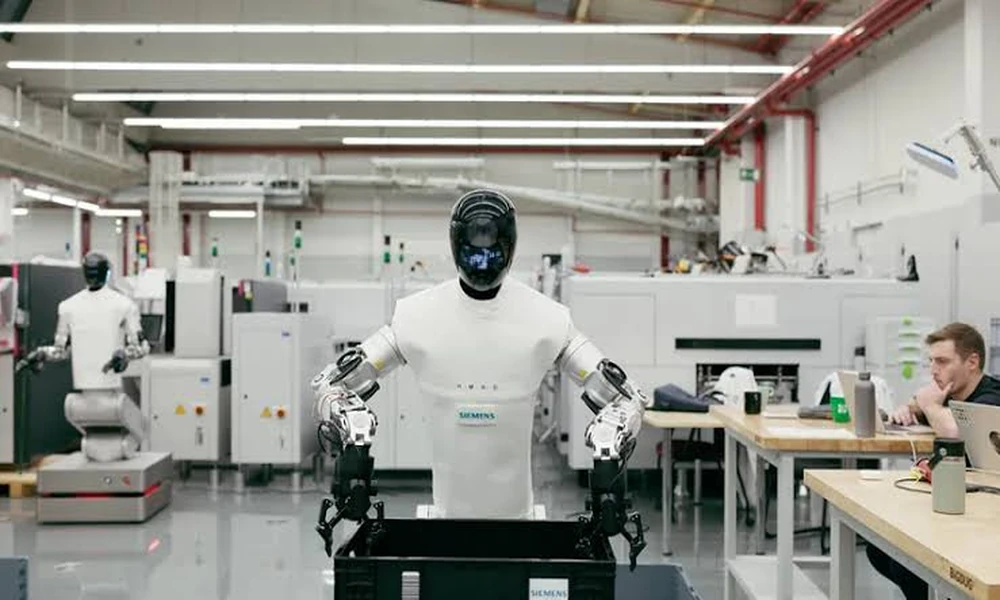
Artificial intelligence in manufacturing is often associated with inspection systems, production forecasting or predictive maintenance. Physical AI addresses a different problem. Instead of analysing information and leaving the physical process unchanged, it combines perception, decision-making and robotic action so that machines can respond to what is happening around them.
The distinction matters because conventional industrial robots are already extremely capable when their environment is predictable. The difficult problem is making them useful when reality does not match an exact pre-programmed sequence.
Traditional robots are precise but literal
A conventional robot does exactly what engineers tell it to do. If a workpiece is expected at a particular coordinate, the robot moves to that coordinate. This behaviour is valuable because it is deterministic and repeatable.
Problems arise when production includes normal variation. A part may be several millimetres away from its expected location, lighting conditions may change, or a workpiece may arrive in a slightly different orientation. A human operator recognises these differences and adjusts almost automatically.
Traditional automation can also handle variation, but engineers usually have to anticipate it and write the appropriate logic in advance. The number of possible exceptions can become difficult to manage in high-mix production.
What does physical AI add?
The concept of physical AI for manufacturing combines sensing with software capable of using that information to influence physical robot behaviour. Vision can identify a part, the control system can determine an appropriate response, and the robot can modify its movement according to the real situation rather than blindly following one fixed trajectory.
Trener Robotics describes its Acteris platform in these terms. The company says the system uses visual, haptic, language and action data to support tasks such as part identification, adaptive movement and robot operation in variable production environments.
These are manufacturer claims and should be evaluated in the context of the specific application rather than treated as evidence that any arbitrary production task can be automated.
Machine tending provides a practical example
CNC machine tending illustrates why physical perception can matter. If every raw part sits in an identical fixture, the robot does not need much intelligence to find it. The fixture has already eliminated most of the uncertainty.
High-mix production may use drawers or flexible part presentation instead. A vision system can then identify the workpiece and guide the robot toward its actual location.
Acteris currently uses vision-enabled part detection in machine-tending configurations and is primarily focused on high-mix automation where job and part variation makes fixed programming more cumbersome.
The benefit is not that the robot becomes “human.” It is that the production environment can tolerate more variation before requiring manual intervention.
Real-time control is as important as perception
Seeing a difference is useful only if the robot can respond appropriately. A physical AI system therefore needs an execution layer capable of adjusting actions while maintaining predictable operating boundaries.
Trener describes its Acteris Runtime as coordinating robot motion and production events in real time, while operators define acceptable conditions for the process.
This separation between autonomy and operator control is important in industrial environments. Manufacturers generally need flexible behaviour, but they also need to know what the system is allowed to do and under which conditions it should stop.
Physical AI will not remove industrial engineering
AI cannot solve every physical problem. A poor gripper remains a poor gripper even if sophisticated software controls it. Bad part presentation, unreliable fixtures or incorrect safety design cannot simply be delegated to an AI model.
The strongest applications are therefore likely to combine conventional engineering with additional adaptability. The process should still be made as predictable as economically reasonable, while AI handles the variation that remains.
Physical AI is most useful when it reduces the gap between the structured world expected by traditional automation and the less predictable conditions found on real factory floors. Its value will ultimately be measured not by how intelligent the robot appears, but by whether that adaptability increases uptime, reduces intervention and makes previously difficult automation economically practical.